
Building a Brand and Busting Tennessee Whiskey Myths: An Interview With Allisa Henley of AJ Bond
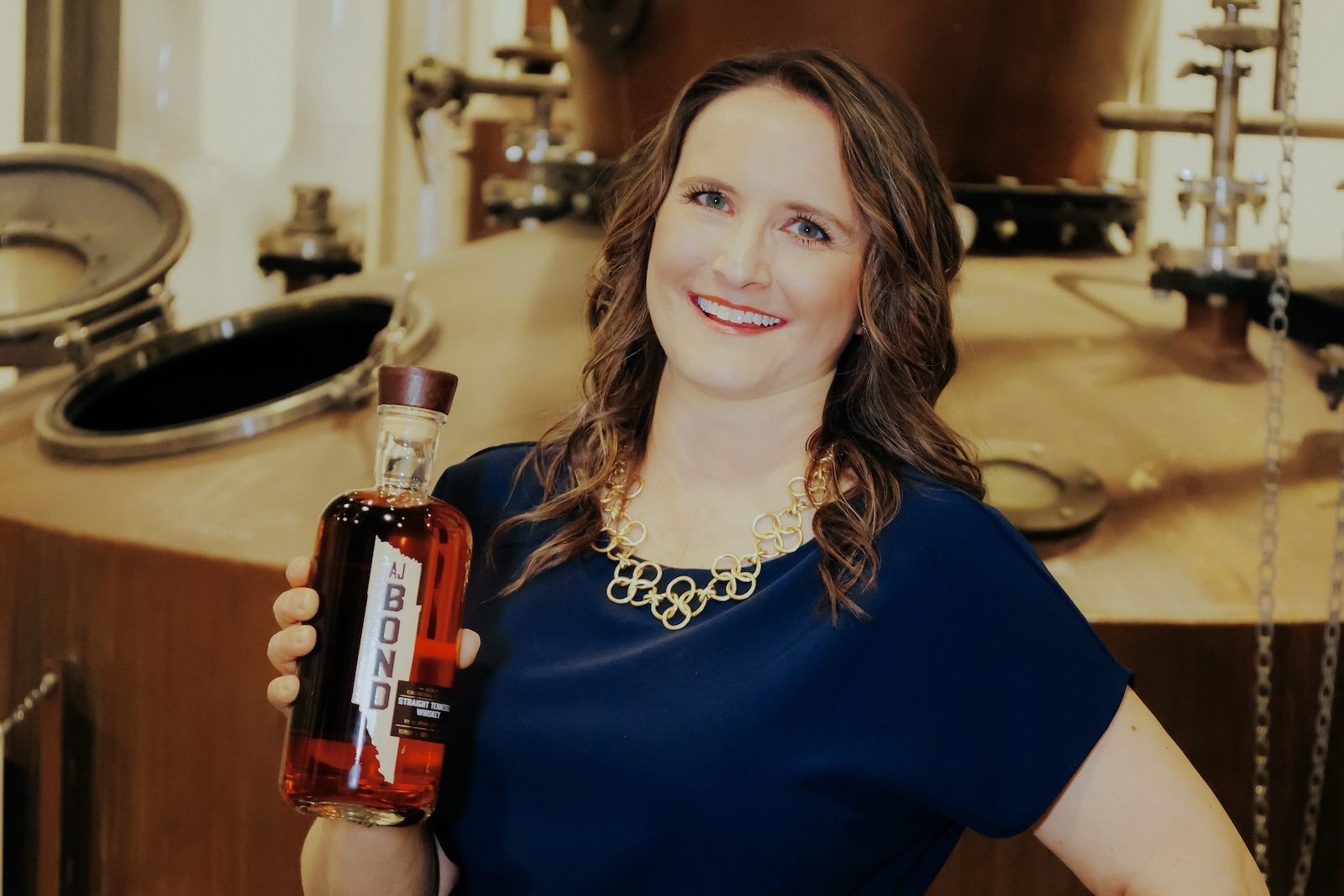
In June 2026, spirits giant Sazerac unveiled its first Tennessee whiskey. Dubbed AJ Bond, the whiskey itself didn’t land as a complete shock. In 2016, the conglomerate bought Newport, Tennessee’s Popcorn Sutton Distillery. In the purchase, Sazerac acquired the expertise of distillers Allisa Henley and John Lunn, both veterans of the Tennessee whiskey industry from their time at George Dickel/Cascade Hollow.
The revamped operation then entered something akin to stealth mode, and Henley and Lunn began tinkering with various distillates and production methods. Roughly a decade later, the new distillery — “A” for Allisa, “J” for John, and “Bond” for their connection — announced its first product. The inaugural AJ Bond Tennessee Whiskey is produced in-house from both column and pot distilled whiskeys. While both liquid streams share a mashbill, the whiskeys are aged separately before blending and bottling at 95 proof.
Tragically and unexpectedly, John Lunn passed away in 2023 at the age of 53. Lunn’s passing was a shock to the Tennessee whiskey community, one felt especially hard by Henley, his collaborator of nearly 20 years. Since then, she’s remained at the distillery’s helm, guiding production and the team toward their first release.
Earlier this year, we sat down with Henley to discuss AJ Bond’s unique path to market. Along the way, our discussions also touched on the distillery’s unique production setup, approach to the Lincoln County Process, and myths and misconceptions surrounding Tennessee whiskey.
Note: This interview has been edited for clarity.

Drinkhacker: How did AJ Bond come to be?
Allisa Henley: John and I both came from the Tennessee whiskey industry. We’d been making Tennessee whiskey for about 12 years when Sazerac came knocking on the door. The CEO came to us and said, “We have all these fantastic bourbons, but we have a hole in our portfolio, and that’s Tennessee whiskey. Who better to help us fill that hole than you and John?”
We were incredibly excited because we’d spent our careers working for a brand that had been around for hundreds of years. We were carrying on someone else’s legacy and talking about someone else’s history. Then someone came to us and said, “We believe in the two of you. Build your own history. Build your own legacy. What would you do if it were your own?”
For us, it was like Christmas morning. It felt like we’d been given the greatest gift imaginable.
That was really the beginning. The conversations started in December 2016, production began in 2017, and we’ve been quietly making and aging whiskey ever since. We’ve really taken our time with this. It was very important to John and me that we do it the right way — that we not rush it, and instead let the aging process do what it does best.
It’s been a long time coming, and we’re very excited for the release. Patience pays off.
Drinkhacker: How did the name come to be?
Allisa Henley: John and I started in the spirits industry within five or six months of each other. We both started in Tennessee whiskey, and neither one of us had come from the industry.
His background was chemical engineering at Vanderbilt, so he was extremely smart and had that engineering brain through and through. On the other hand, I have an MBA, so I have a business background. Funny enough, both of us got into the industry by responding to an ad in a newspaper, which probably dates my age a little. We both responded to ads. Mine was for George Dickel, where we both ultimately worked. They were looking to open the distillery to visitors. They didn’t have a visitor experience, so they wanted me to create that experience and manage it.
I learned real quick that one of the things I had to do was write a tour script for our employees to teach people about whiskey. I knew absolutely nothing about it.
I thought, “Well, I can’t write a script if I don’t understand it myself.”
That really started my hands-on education in whiskey and the production process. I would just go out into the distillery, and I was lucky enough that it was all men who had been there for 20 or 30 years. They let me bug the crap out of them. I’d say, “Let me do this. Tell me why we’re doing this.”
I got very hands-on, and they were incredibly kind in teaching me what they’d been doing for decades. During that process, John and I formed not only a friendship but a great working partnership. We really played to each other’s strengths. He was the engineer, with the chemistry and analytical side of things. I had the business mindset, with marketing, PR. And I was the people person. It just worked. We played off each other’s strengths and built an entire career that way.
When we both left Dickel, the executives at Sazerac knew both of us, and they said the key to starting their Tennessee whiskey project was hiring both of us together as a team. If we hadn’t come as a team, it probably wouldn’t have happened. We really did have a special bond, which is partly why we chose the name AJ Bond.
We even had a saying: “Where you go, I go.”
Looking back, I do miss having John there to bounce ideas off of. His learning was more classroom-based, while mine was definitely more hands-on and centered around not being afraid to get out in the distillery and get dirty.
Drinkhacker: Thank you for sharing that. I’m sure recounting that — especially about someone you’ve worked so closely with, built a career alongside, and who has since passed — isn’t easy.
Allisa Henley: Honestly, John knew the name was going to be AJ Bond before he passed, so I’m glad he knew that and was excited about it.
It’s hard when you’ve worked side by side with someone for 20 years and they’re not here to see the finished product. But I know he’d be proud of it. I know he’d be excited. In part, this has also helped keep his name and legacy alive. We’re very excited for the launch.
Drinkhacker: Where has the whiskey been produced?
Allisa Henley: When this all started, production was in Newport, Tennessee, in East Tennessee.
John had left Dickel to work for a small company called Popcorn Sutton. I stayed at Dickel for another two years, and then he called me and basically said, “I miss working with you. You’ve got to come work with me.”
I was ready for a change. I’d been with Diageo for 12 years, and this felt like an opportunity to do something different, especially since we knew Sazerac was looking at opportunities. So I joined Popcorn Sutton. About four months later, Sazerac came along and said, “We don’t really want the Popcorn Sutton brand. We want the equipment, the people, and what you bring to the table.”
We were all on board. At that point we were operating in Newport, where the original distillery was located. We immediately started looking for property in Middle Tennessee. To me, East Tennessee has those mountain moonshine vibes, and that’s wonderful, but it wasn’t what we wanted to build. We wanted to make a true aged Tennessee whiskey. John and I are both from Middle Tennessee, so it also felt like coming home.
We purchased property in Murfreesboro, about 30 minutes south of Nashville. Right now that’s just a green land property. So in the interim, we’ve been leasing a facility in La Vergne, about 15 minutes south of Nashville. So we’re still very close to Nashville.
You wouldn’t even know we’re there. It’s funny because you’d never know what was inside from looking at the building. But once you open the doors, it’s the coolest place you’ve ever been in, it feels like a distillery. We moved from East Tennessee around 2020 or 2021, and we’ve been in La Vergne ever since.
Drinkhacker: Let’s talk a little bit about the whiskey itself. The initial release blends both pot and column still whiskeys. Can you tell me a little bit about those two components?
Allisa Henley: When Sazerac acquired the operation, they inherited the pot stills from Popcorn Sutton. When we moved to Middle Tennessee, we added a column still. Most distilleries have one or the other, or a combination still, but not separate pot and column still operations like we do.
John and I started thinking about it. We’d worked together as a team for 20 years. There were two of us, and now there were two different styles of distillation. We didn’t want people to think of it as a blended whiskey because technically it isn’t. It’s the same mashbill. We’re distilling it on two different types of equipment and then mingling those barrels together later.
The pot still whiskey has more character. It’s deeper, with a little more going on. The column still whiskey is cleaner and crisper. Those differences remain throughout aging. Originally, the plan wasn’t necessarily to combine them. We just wanted to make great whiskey and see how it developed. But once we settled on the AJ Bond name and thought about what it represented, we realized how fitting it was that these two distinct styles could come together. It gives us something that’s genuinely unique in the industry.
Drinkhacker: Let’s talk a little bit about the Lincoln County Process. How do you approach that? Is it different for the pot still whiskey versus the column still whiskey?
Allisa Henley: No, the process is the same. The Lincoln County Process is what makes Tennessee whiskey Tennessee whiskey. For us, we actually make our own charcoal. The law requires maple charcoal. We specifically use sugar maple. You can buy charcoal commercially, but you can’t always guarantee exactly what type of wood it came from. So we make our own.
Very few Tennessee distilleries still do that. We purchase sugar maple logs, stack them into large four-by-four ricks, and every so often we basically have a giant bonfire. That’s how we make our charcoal. It’s a very important part of our process and one of the things that really distinguishes Tennessee whiskey from bourbon.
Drinkhacker: What do you think are some of the biggest misconceptions about Tennessee whiskey?
Allisa Henley: I think when people hear “Tennessee whiskey,” they immediately think of one particular brand. They associate it with that bite or harshness rather than something you’d sit down and sip and really enjoy.
We’re trying to show people something different. We want to produce an aged Tennessee whiskey that’s versatile, something you can sip and appreciate without that harshness people may expect.
The other debate is whether charcoal mellowing adds flavor or takes flavor away. People could argue about that all day. My opinion is that charcoal is a natural filter. It removes fusel oils and fatty acids, allowing the flavors you actually want to come through more clearly. To me, it enhances the whiskey rather than taking anything away.
It’s funny because within Sazerac we have distilleries in Kentucky too, and everyone jokes that bourbon is the best. Of course, I argue that Tennessee whiskey is the best.
Drinkhacker: Is Tennessee whiskey technically a subcategory of bourbon, or should we think of it as completely separate?
Allisa Henley: I’d argue it’s a subcategory. Technically, if we made Tennessee whiskey, put it through the charcoal mellowing process, and decided to label it as bourbon, we legally could because it meets all the requirements for bourbon.
But my question is: why would I? I’ve taken it one step further to make Tennessee whiskey. I like explaining it as a hierarchy. At the top you have whiskey. Below that you have categories like American whiskey, Scotch, Irish whiskey, and Canadian whisky. Within American whiskey, you have bourbon. Within bourbon, you have Tennessee whiskey.
As you move down each level, you’re simply adding another set of requirements.
The post Building a Brand and Busting Tennessee Whiskey Myths: An Interview With Allisa Henley of AJ Bond appeared first on Drinkhacker: The Insider’s Guide to Good Drinking.